every admissions cycle, we ask three questions.
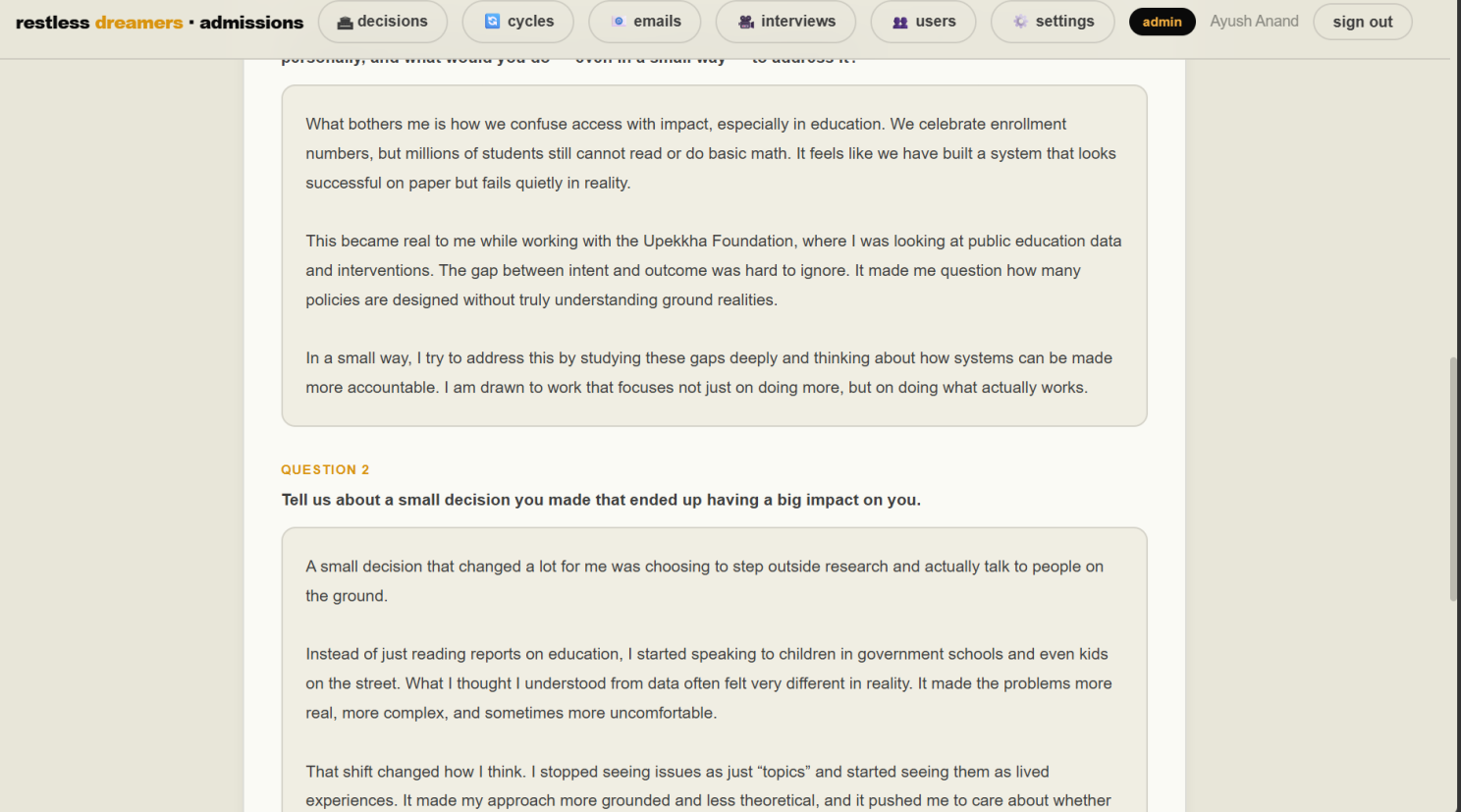
not “what’s your GPA” or “list your internships.” we ask: what problem bothers you? what small decision changed your life? and what makes you lose track of time?
and every time someone asks us why we ask these, the answer is the same. because the things that matter most about a person almost never show up on a resume.
why these questions, and not the obvious ones
credentials tell you where someone has been. these questions tell you how someone thinks.
the first question, what problem bothers you, isn’t really about the problem. it’s about whether a person has been paying attention. to the world around them, to the gaps that most people have learned to ignore. someone who is genuinely bothered by something has skin in the game. they notice. they care. and at RD, we need people who notice.
the second question, what small decision changed your life, is perhaps the most revealing of all. because life rarely turns on grand gestures. it turns on quiet moments of courage. a hand raised in a room full of silence. a yes given for someone else’s sake. a pivot made without a safety net. when someone can identify that moment and articulate what it taught them, it tells us they are the kind of person who learns from their own life. and that is a rare and valuable thing.
the third question, what makes you lose track of time, is about joy. genuine, unselfconscious joy. not ambition dressed up as passion, not a skill they’ve been told to monetize. just the thing that pulls them in so completely that the clock stops mattering. we ask this because we believe that people who have found what genuinely excites them are fundamentally different learners. they don’t need to be pushed. they need to be pointed.
together, these three questions are trying to find the same thing: a person who is alive to their own experience. curious. honest. and not yet convinced that the world is fixed.
that’s who RD is built for.
what 230 answers looked like
and then the applications came in. and as always, they reminded me why we ask these questions in the first place.
the person who applied for a friend, and found themselves
one applicant wrote about joining their school’s legal society not because they wanted to, but because a friend was too scared to apply alone.
that one selfless act, showing up for someone else, pulled them into debates, legal research, policy discussions, and eventually into a leadership role they never asked for. the ripple didn’t stop there. that accidental yes put them on the path to CLAT preparation, and they ended up with an All India Rank of 244.
AIR 244. from a decision they made for someone else.
i keep coming back to this one because it says something important: the most significant turning points in a person’s life often don’t announce themselves. sometimes they look like a favour.
the person who fainted on stage, and then led the assembly
another application described a student who went completely blank during a school speech and fainted. the kind of public humiliation that makes most people quietly decide to never try again.
and they didn’t, for years.
then, on the very first day at a new school, when their teacher asked if anyone wanted to lead a five-day assembly, no hand went up in a room of 62 students. except one.
still scared. still shaking. they did it anyway.
their peers told them after: they didn’t even look like a first-timer.
that person has since won regional debates, presented research at the state level, attended MUNs, and won a national gold medal in Taekwondo. none of that happens without the courage of one raised hand in a room full of silence.
the person who turned a junkyard into a garden
one applicant described walking past a neglected, filth-ridden junkyard in their neighbourhood every single day, until they decided to speak to the local authority about it.
that conversation led to an eco-club. the junkyard became a garden. and somewhere along the way, that same applicant developed AI models to combat air pollution, proposed hydrogen-based engine transitions, won a solving-for-humanity challenge, and got to present their work to the UNDP.
all of it. from stopping at a junkyard.
the girl who left home
in a country where it’s still not easy for young women from smaller cities to pursue education away from home, one applicant wrote simply and honestly about convincing her family to let her study in Delhi.
she didn’t frame it dramatically. she just said: “i kept my points. i made a promise. they believed me.”
and now she’s there. studying. building. doing exactly what she said she would.
i think about the weight of that quiet courage. no junkyard-to-garden arc, no competition ranking. just a girl who made a case for her own life and won it
the one who moved 1500km from home
another application mentioned leaving NEET preparation, not as a failure, but as a liberation. the month they stopped, they started reading balance sheets, studying company histories, and following their actual curiosity. they moved 1500 kilometres from home for a course they chose for themselves, with their parents’ support.
1500 kilometres. for a choice that was finally theirs.
what we’re really looking for
reading 230 applications reminds me every single time why RD exists.
not for the student who has already figured it out. for the one who applied for a friend and discovered themselves. for the one who raised their hand in a room full of silence. for the one who turned a bother into a movement.
a well-designed question doesn’t just collect information. it creates a mirror. and what we’re hoping people see in that mirror, when they sit down to answer honestly, is something they might not have said out loud before. something true about who they are and what they’re made of.
that’s what these questions are for. not to filter people out. to let the right people in.
and this cycle, the answers reminded us, we’re finding them.