every weekend
ideas, conversations & experiments -
yes, our ice for every weekend is a lil different 😉. we talk about consumer behavior, BATNA, Fix-Sell-Close and what not?
your ice is just a form away <3
well well well, what's ICE? 🧊
ideas
- so, we discuss one idea with you every weekend for an hour or so - it could be on marketing, psychology, strategy, public policy or even stats?
conversations
- we use your understanding as a baseline through an activity and then, we try to tell you what the idea exactly means - let's say consumer behavior: its not always coming from the consumer's pov but also from design thinking, who knows?
experiments
- finally, we do an activity again - to figure out how much we all understood from the session. everyone has a different learning and every outcome is discussed and deliberated.
here's the plan for the weekend!
of course, we are going to be smart!
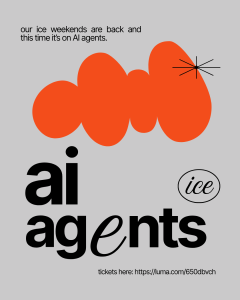
​Forget chatbots. The frontier has moved. Companies aren’t just using AI to assist workers – they’re deploying AI agents that autonomously plan, decide, and execute: booking meetings, triaging customers, managing supply chains, flagging fraud. No human in the loop. No pause for approval.
Most technology gets adopted because it’s better. Agentic AI is getting adopted because it’s cheaper and faster – and the “better” question is being asked afterward, if at all. That gap – between deployment speed and governance readiness – is where the most important decisions of the next decade will be made.
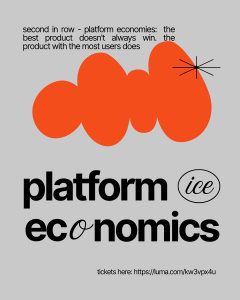
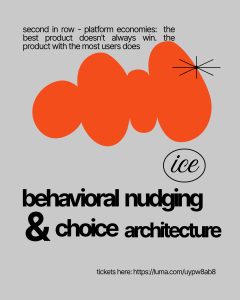
​When you open Swiggy, book an Ola, or pay via UPI, you’re not just using an app. You’re participating in a market that someone designed – one where the platform sits in the middle, connecting two groups who need each other.
​More restaurants make Swiggy more useful for diners. More diners make Swiggy more valuable for restaurants. The platform doesn’t produce food – it produces connections. And the more connections it has, the harder it becomes for anyone to replace it.
​Amazon doesn’t just show you products. It shows you “Only 2 left in stock” and “4 people are viewing this right now.” Swiggy doesn’t list restaurants neutrally – it leads with “Order again?” because re-ordering requires zero decision-making. Zepto’s checkout defaults to a tip for the delivery partner, already selected, already highlighted in green.
​None of these are accidents. None involve force. They work because human beings don’t make decisions the way economics textbooks say we do – we’re shaped by defaults, social proof, loss aversion, and how a choice is framed. Behavioral design is the science of engineering those influences – deliberately, at scale.

so how
can i
be a part
of it?
step 1: signup
just fill up a form with your cute name, email, whatsapp number & sorted!
step 2: all done <3
yes, that’s it! we will send you an invite and also also, we will
take step 1 today, to take 100th step tomorrow.
that’s the classic, we have – you are into an enriching discussion, just a form away <3. also, all the topics could be viewed from the dashboard.